Designing streets for everyone
Applying a universal design lens to pedestrian planning
CUDA founder and Steering Committee member, Dr Jane Bringolf will be presenting a poster at the 8th Annual Universal Design Conference in Ireland on her work with Austroads to review and update its Pedestrian Planning Guidance for transport professionals.
The conference brings together experts, practitioners and academics from around the world to explore new thinking, research and practice in universal design, with a focus on creating more inclusive places, systems and experiences.
You can read more about the conference at UD26.
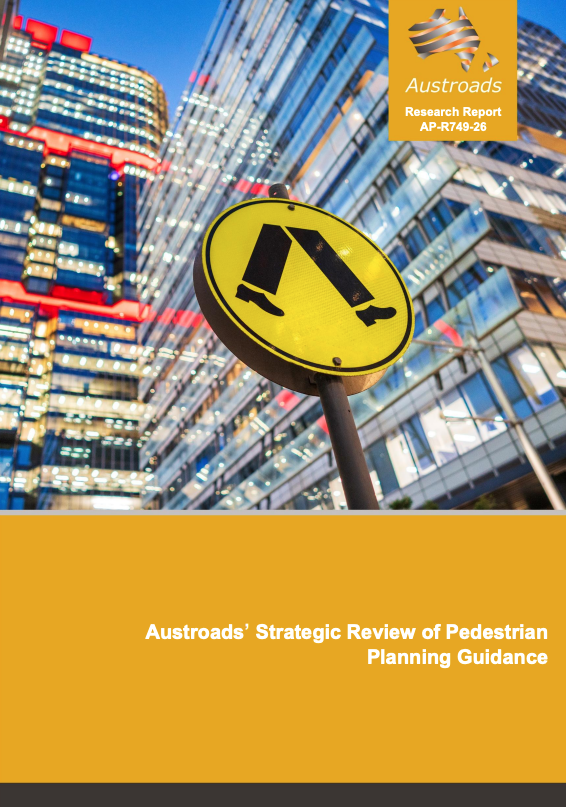
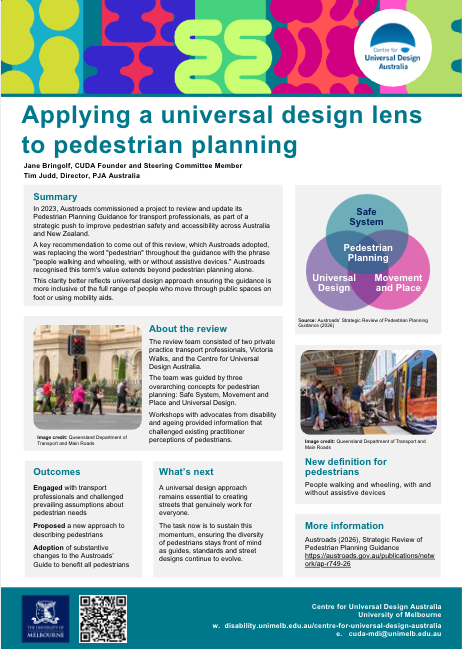
You can view the report as well as Jane’s poster below.
 |  |  |
|---|
Download the poster
The Word version is screen‑reader accessible and design‑free. The PDF version is the printed poster that will be displayed at the conference. If you would like another format, please reach out to us at cuda-mdi@unimelb.edu.au.
A recent news feature from Jane is also included below, offering further insight into this work.
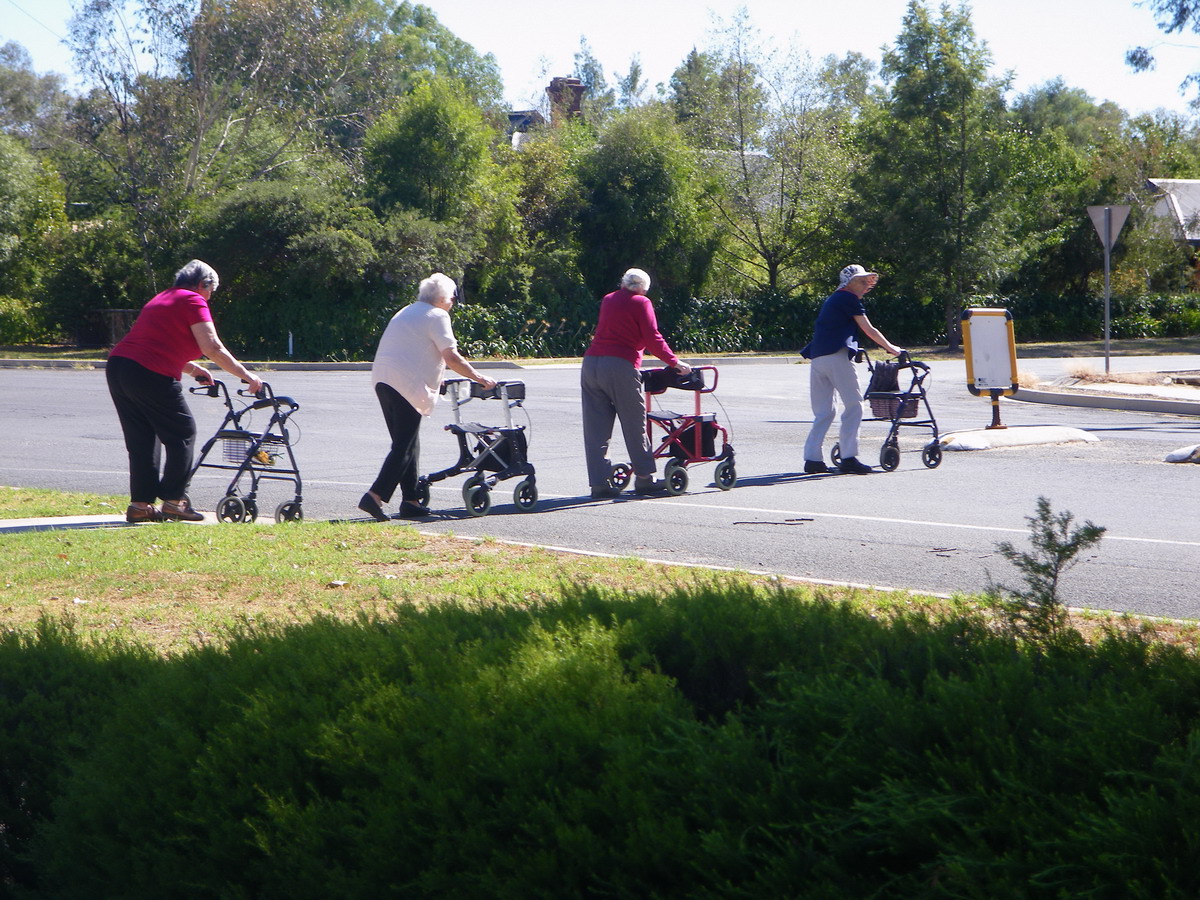
Image credit: Dr Jane Bringolf
Pedestrians are people, that much is obvious. But the word ‘pedestrian’ has a way of glossing over the rich diversity of how people move about in their everyday lives. It hides the reality that we all walk, wheel, pause, navigate and participate in different ways. It is why a universal design approach to pedestrian planning is so important. That way we can shift the focus to real lives and real experiences.
From 2022 - 2025 I was a part of the project team reviewing the pedestrian section of the Austroads’ Guide to Traffic Management. For me, there were three key outcomes from the review. First, it was an opportunity to engage with transport professionals and challenge their assumptions about pedestrian needs. Second, we were able to propose a new way of describing pedestrians. Third, we recommended real changes to the Austroads’ Guide that would benefit all pedestrians.
Looking back over the last few months, it's been encouraging to see the language and thinking from that review filter into broader conversations about pedestrian planning, even though there is still a long way to go before it's fully embedded in everyday practice.
Who are pedestrians?
To remind transport professionals of the diversity of the population we came up with a descriptive phrase to use instead of pedestrian: ‘people walking and wheeling with and without assistive devices’.
‘Wheeling’ can be any device with wheels: a pram, shopping trolley, wheelchair, or mobility scooter. An assistive device might be a cane or wheeled walker.
We chose this term to serve as a reminder to transport professionals that pedestrians come in all shapes, sizes, ages and levels of capability. Words matter and this term kept a universal design focus throughout consultations and subsequent recommendations to Austroads.
Strategic transport planner and engineer, Tim Judd, led the review team. He admits that population statistics were a wake-up call for him. In an interview he said, “I never saw those statistics before, that up to 40% of the population with either a disability or long-term health condition could be impacted by road and street design. It really hit home to me.”
Judd also remarked that the transport network has to plan and design for our lifespan. “As a child you need assistance from your parent who in turn wants an accessible system. As an adult you can break your leg and need good accessibility, and as you get older your needs evolve and change again.”
The review used three overlapping and overarching concepts for Pedestrian Planning: Safe Systems, Movement and Place and Universal Design.
Safe Systems
Being safe is one thing, but people want to feel safe. For example, wide crossings in heavy traffic are scary if you have a wheeled device or walk slowly – even when the crossing is signalised.
Impatient drivers also make slow walkers feel unsafe and a nuisance. A key point in our report to Austroads was that drivers need more education to understand traffic rules in relation to giving way to pedestrians.
The crossing time for pedestrians at signalised crossings is based on moving at 1.2m per second. However, not every pedestrian can walk at this speed – a point raised by disability and ageing advocates during consultations for the review.
Safety is a concept that transport professionals take seriously. Consultations with professionals revealed that a universal design approach was a new concept. However, the Safe System approach was not.
Movement and Place
The Movement and Place Framework is about improving the liveability of suburbs, activity centres, and business districts. However, safe, comfortable and pleasing pedestrian infrastructure is needed between places, not just in places such as shopping and dining precincts.
Decent footpaths, seats at regular intervals, and shade can encourage more walking for more people in local neighbourhoods.
‘Journeys not made’ was a regular feature during the consultations with disability and ageing advocacy groups. These are trips that people want to make but either cannot or choose not to make. Several factors contribute to this.
Poorly designed or missing footpaths and kerb ramps become barriers, and signalised and other crossings can feel unsafe. Shared paths and thoughtless cyclist behaviour also contribute to feeling unsafe. Add the weather and other aspects of discomfort and it is easy to see why some people avoid making a journey.
Journeys not made also impact mental health and general wellbeing and reduce incidental socialisation.
Universal Design
Universal design is about planning streets and public spaces so they work for everyone, regardless of age, mobility, sensory needs or how people move through the world. During the review, many transport professionals said this was a new concept for them, even though they were familiar with safety frameworks like Safe Systems. Universal design shifts the focus from “designing for the average pedestrian” to recognising the full diversity of people walking and wheeling. It asks planners to consider comfort, confidence, dignity and independence, not just compliance.
As for my part in this project, I found support and acknowledgement for improved accessibility and inclusivity depended very much on who was represented in the working groups and decision-making committees. Consequently, not all recommendations were welcomed by all.
However, our report has paved the way for people walking and wheeling with and without assistive devices to be considered more broadly in future updates to Austroads’ publications.
I remain convinced that a universal design approach is essential if we want streets that genuinely work for everyone. The task now is to keep that momentum going, making sure the diversity of pedestrians remains front of mind as guides, standards and street designs continue to evolve.
The full report with recommendations is available on the Austroads website.
Authors note: My thanks to Tim Judd, Director, PJA Australia for his contribution to this article.