A Fair Start: Extend Paid Parental Leave
A call for extended paid parental leave for families of babies requiring extended hospitalisation at birth
In Australia, approximately 18% of newborn babies are admitted to a neonatal intensive or special care nursery each year. While most babies will be discharged home soon after birth, 5-6% will spend more than 2 weeks in hospital.
For parents of these hospitalised babies, much of their paid parental leave is exhausted before bringing their baby home. This raises grave concerns, as families with preterm or sick babies face higher risks of anxiety, depression, stress, and neurodevelopmental challenges in their children. Financial pressures often force parents to return to work whilst their baby is in hospital, separating the family.
Our research shows:
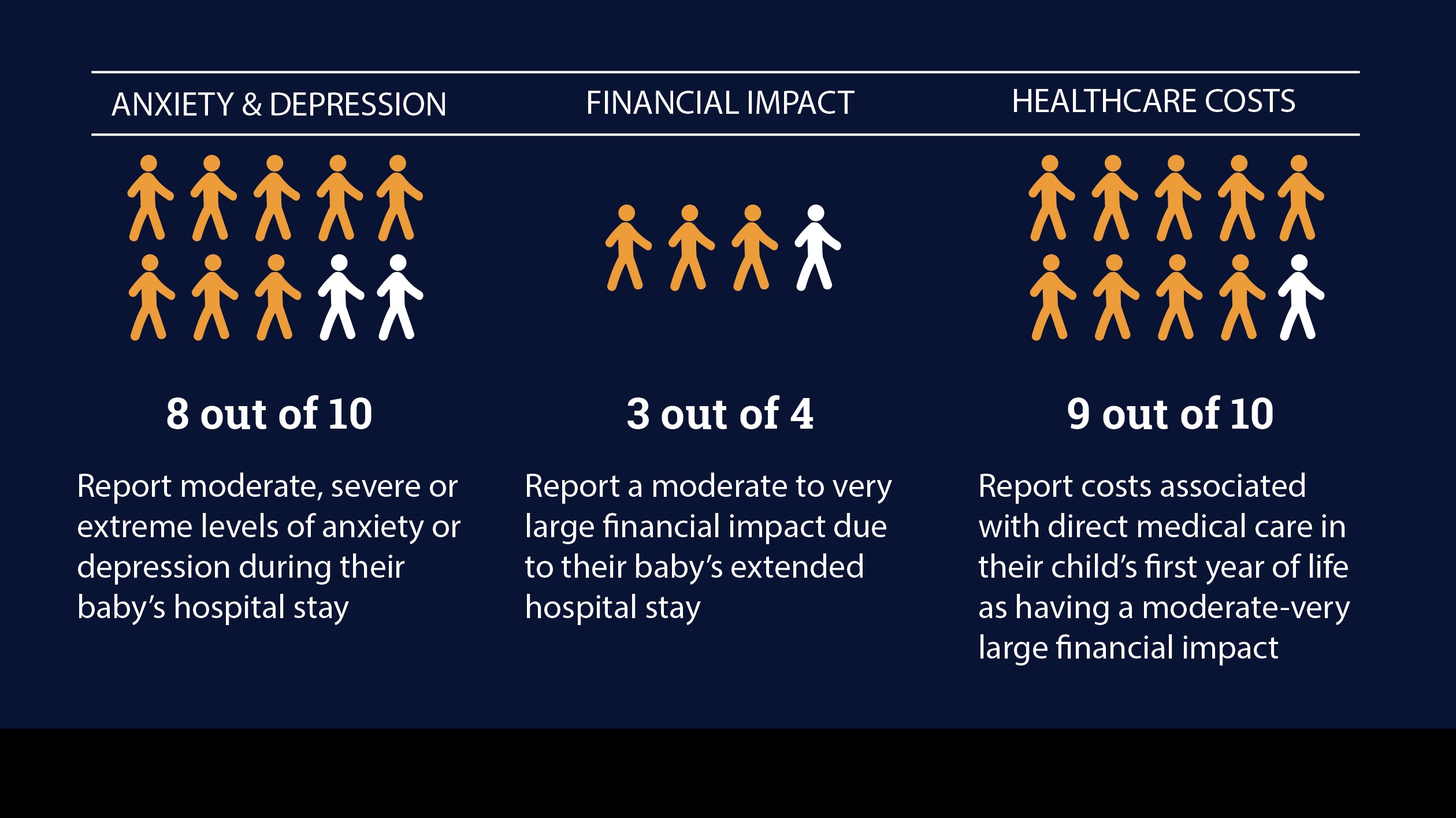
The time these babies and parents spend together in the early developmental period, during the hospitalisation and after discharge, is crucial for optimal child development and bonding. However, caregivers whose babies are admitted to neonatal intensive or special care for extended periods are not currently entitled to any extra parental leave payments from the Australian Government, despite the critical importance of this time.
The Proposal
The Neonatal Critical Care (NCC) Alliance recommend the Australian Paid Parental Leave Act is changed to allow primary carers access to 1 week of extra parental leave pay for every week in hospital (for babies admitted to hospital for more than 2 weeks), up to a maximum of 14 weeks. For secondary carers of these babies, the NCC recommends an additional 1-2 weeks of extra parental leave pay depending on the baby’s length of stay.
The Cost
Of the estimated 280,000 births each year, approximately 15,000 babies require hospitalisation for greater than two weeks. Based on the current primary and secondary carer workforce rates, the NCC would expect about one-half of these families to take up the proposed scheme. The cost would be approximately $44 million - less than 1% of the 2026-2027 allocated budget.
The Benefit
Based on indicative modelling, the benefits of the proposed scheme are likely to outweigh the costs due to: medium to long term productivity gains with care givers more likely to return to and stay in the workforce long term; improved parental physical and mental health; and, likely long term benefits for parent, child and family health and wellbeing.
The Australian Government’s Early Years Strategy 2024-2034 sets out a vision for all children to thrive in their early years. This proposal directly supports two key pillars of this strategy: Ensuring children’s health and wellbeing and strengthening family support services.
Voices of those with lived experience
The impact of having a baby born early or unwell - insights from lived experience
-
“In February 2020, I gave birth to my son - Arkie George Marr - at just 28 weeks. We spent close to three months in the Neonatal Intensive Care Unit at Royal North Shore Hospital in Sydney before we were able to be transferred closer to home in Orange, NSW. Arkie then spent further time in the Special Care Nursery at Orange Health Service. By the time we were able to take our beautiful boy home, I had exhausted the majority of my paid parental leave. The thought of returning to work after just a matter of weeks with him at home was distressing and we made the decision that I would stay at home while my husband went back to work. This was an incredibly stressful time for our family - not only were we dealing with the usual feelings of bringing a baby home and getting into a routine, but I had also begun to show signs of postnatal depression and anxiety as well as post-traumatic stress disorder - only exacerbated by the fact that we were trying to get by on a single income. I am a very driven and focused individual and had always been proud of my career and ability to contribute financially to our family. The disparity that currently exists in the Paid Parental Leave Scheme left me feeling incredibly isolated and stressed at a time when I should have been able to enjoy the time finally bonding with my baby. Extending the Paid Parental Leave Scheme for families with a sick or premature baby would better assist in many ways.” – Mum, Rosie Pritchard
-
“Every day in my role as consultant RN in the Neonatal Intensive and Special Care unit I see parents that are impacted financially and professionally by the sudden, unexpected preterm birth of their baby. Both mothers and fathers juggle meeting the comfort and safety parenting needs of their preterm hospitalised infant, and the financial pressure that requires them to continue to work during this very stressful, demanding time.” – Megan Bater, Neonatal Nurse
-
"My husband and I had our firstborn son, Josiah, at just 24+4 weeks in December 2024, 3 months early. Of course, this meant I started my Centrelink maternity leave 3 months early, losing those 3 months of full-time work (I don’t receive employer paid parental leave). We would have had to fund longer maternity leave ourselves. My husband’s employer provides paid parental leave, along with special pre-term leave (fully paid). This was a lifesaver. And it meant more to us than we could have imagined, aside from financially. It meant my husband could be with me, living in the carer’s accommodation at the hospital (away from our home), whilst Josiah was in NICU. We saw so many Mum’s in there alone. Little did we know, 7 weeks into our journey, our son would tragically pass away from a rare complication. I cannot begin to imagine how much harder the journey and grief would have been had my husband had to go back to work during that time in NICU. Because of the special leave, he had precious time with our son, that so many Dads weren’t getting in NICU. Had Josiah lived, my parental leave payments from Centrelink would have been over by the time we got home from the hospital (which originally was guessed to be soon after Josiah’s original due date). Aside from the financial benefit of special pre-term leave, the emotional benefits go even further. I can’t advocate for this type of leave enough. I dread to think what we would be feeling had my husband not been with me in NICU, and with our son for that precious time we had with him.” – Mum, Jessica Codrington
Show your support
Families of premature babies often miss out on income during the hospital stay and use up their paid parental leave before bringing their baby home. This can force parents to return to work earlier than planned. Improved legislation providing additional special leave for the hospital period will support these families. It will reduce separation between parents and babies, and assist more women to return to the workforce when they are ready.
For families
Families can get involved by writing a letter, sharing their story, posting on social media, and adding their voices to the call for better support for parents of hospitalised babies.
Read moreFor healthcare organisations and professionals
Healthcare professionals and organisations can get involved by writing a letter, signing the register of support, sharing messages online, and helping amplify the call for better support for families of hospitalised babies.
Read moreFor organisations
Add your organisation to our register of supporters and stand with us to create better outcomes for premature and sick babies.
Register hereAccess more information and resources
- Paid Parental Leave - One Page Summary (pdf) (PDF File 197.3 KB)
- Paid Parental Leave - One Page Summary (word) (MS Word Document 121.7 KB)
- Journal - Impact of current Australian paid parental leave on families of preterm and sick infants (PDF File 1.1 MB)
- Fact Sheet - The impact of current paid parental leave on families of preterm and sick babies (PDF File 2.5 MB)
- Journal - Missing out on precious time: Extending paid parental leave for parents of babies admitted to neonatal intensive or special care units for prolonged periods (PDF File 1.2 MB)
Published articles
- Spittle, A., McKinnon, C., Huang, L., Burnett, A., Cameron, K., Doyle, L., Anderson, P., Baird, M., Colditz, P., Cruz, M., Pussell, K., Dalziel, K., Eeles, A., Newnham, J., Hunt, R., & Cheong, J. (2022). Missing out on precious time: Extending paid parental leave for parents of babies admitted to neonatal intensive or special care units for prolonged periods. (1440-1754 (Electronic)).
- Eeles, A., Olsen, J., Cameron, K., McKinnon, C., Rawnsley, K., Cruz, M., Pussell, K., Dubois, K., Hunt, R., Cheong, J., & Spittle, A. (2022). Impact of current Australian paid parental leave on families of preterm and sick infants. (1440-1754 (Electronic)).
Online
- Eeles, A. L., & Spittle, A. J. (2023). The Australian paid parental leave scheme has no provision for babies born prematurely or unwell, it’s time for a change to support all families. https://pursuit.unimelb.edu.au/articles/parents-of-premature-babies-are-being-left-behind
The University of Melbourne and Miracle Babies Foundation proudly lead the Neonatal Critical Care Alliance, joined by Heart Kids, Tresillian, Cerebral Palsy Alliance and Birth Trauma Australia. This Alliance has come together to expand advocacy for increased support for our most vulnerable babies and families, particularly during the neonatal critical care period.
